skip to main |
skip to sidebar
I this morning wanted to see if the term "plus one" is defined anywhere in its nounular form, as used in Doctor Who (series 1, ep 2) when the Doctor says, "See, it says right here: 'The Doctor Plus One.' I'm the Doctor, and this is Rose Tyler. She's my Plus One." For the CDes Halloween party, good friend M. will be my Plus One, hence the relevance of the topic.
I went to UrbanDictionary.com - not necessarily a scholarly resource, but fun to peruse on occasion, and saw the term "fives" in a use I'd not previously known. Definition 3 is my fave, because it illustrates growth in the meaning of the term:
Defines a claim or ownership of a certain item. Originally used to define such a claim for 5 minutes, but is now commonly interchanged with the word dibs.
The one bit lacking from this is the bit about how it originated as a way of claiming rights to a seat so that one can go use the loo, refresh one's drinky, or the that.
Oh, and I never did find a prior use of "plus one" as a noun phrase.
My lappy died last week. It's still under warranty for a few more months, but blah blah words, I'm replacing it. We'll ship it in & see if they can fix it, & if so, then Ben has a lappy too. Yay! The sad part is that despite my vehement exhortations that I would never buy another Windows box, I can't afford right now to (a) buy a Mac and (b) buy Mac versions of the software I need for school. So I'm trapped in Windows land again. This makes me grrr. But so what? How does this affect you, the reader? I'll have limited access to the Internets until my new lappy arrives, and so will not post as often. The result is that you will need to find another way to spend your hard-earned Internets time.
Random fun notes:
An issue of the Minnesota Daily last week included a story about a first-year student (18 or 19 yrs old) who last spring (1) went to a party, (2) was served alcohol by a 20-year-old student, (3) become very intoxicated (0.31% blood-alcohol level), (4) left the party, and (5) fell to his death from a parking structure. All tragic & shit, but my favorite part is the end of the story, where the UMPD's chief is quoted as saying, "A death like this can have life-changing effects."
In today's Daily, a front page story about sports injuries includes this gem from Jennifer Kearns, associate director of NCAA public relations: "It could be a temporary condition or it could be, in some cases, a permanent condition." Really. It could be either one of those. So, y'know.
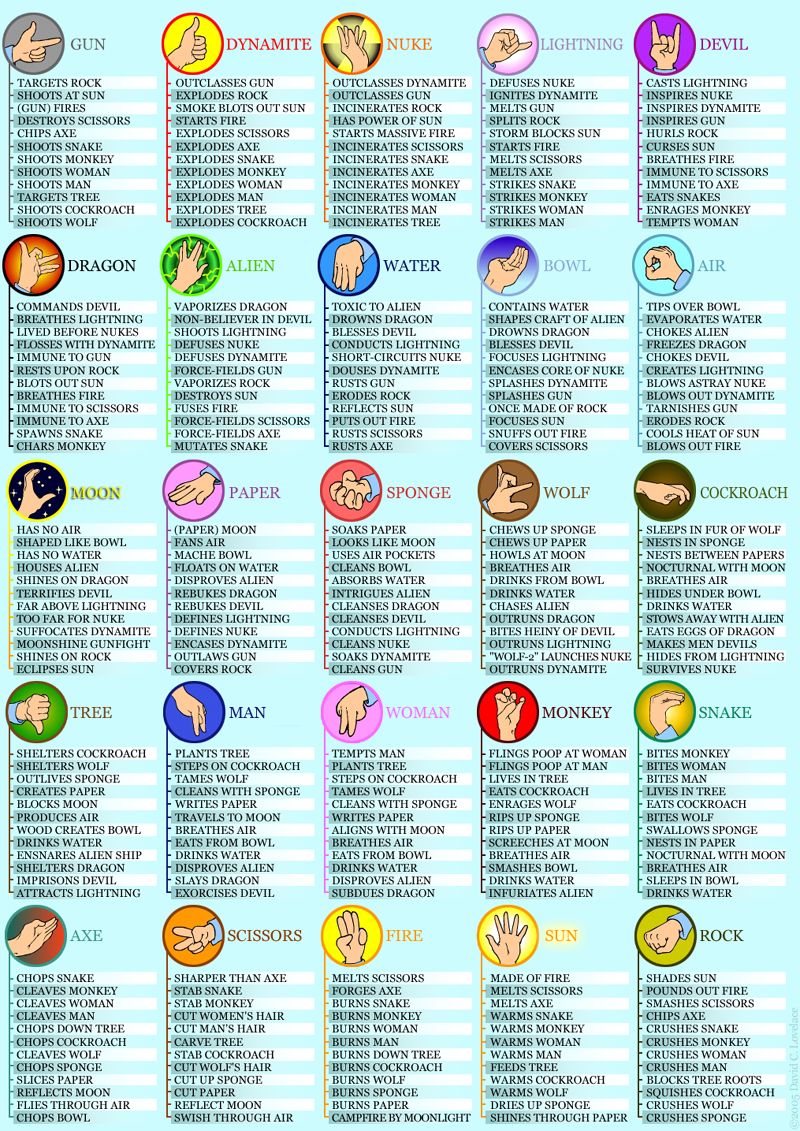
Ahh, the old game of Rock-Paper-Scissors... perfect for making those tough life decisions: Who's going to make dinner? Whose turn is it to ask for an abortion? Which person gets a new desk? But what if we threw a couple more choices in there?
RPS-25 was created to provide a more complex game with more possible outcomes. Each item is dominant over 12 others, and the result is 300 possible outcomes. But why stop there? The inventor of RPS-25 took things 76 steps further & gave us RPS-101. Each gesture defeats 50 of the remaining 100, the result being a total of 5,050 possible outcomes.
Some of my favorites:
DYNAMITE explodes BABY (actually, DYNAMITE explodes a lot of stuff....)
SPIDER in your BEER
BEER diffracts LASER
MATH confuses PRINCESS
MATH enrages MONKEY
SCISSORS alert AIRPLANE security
and any of the BRAIN ones....
BRAIN invents BUTTER
....... foils VAMPIRE
....... performs MATH
 This morning I saw this image on the side of a city bus. I giggled because I saw it as a figurative representation of one method to prevent fetal alcohol syndrome: don't get pregnant. Then I realized they didn't intend it that way. Oops!
*I didn't have time time snap a photo, but pulled the imaged from the Minnesota Organization on Fetal Alcohol Syndrome web site.
If I ever write a text book, I'm going to try really hard to make it actually useful. And provide relevant content. And make sure it's clear - or at least reasonably so.
Within the first 3 days of classes, I've been frustrated by both of my textbooks.
In one of them, the author(s) is/are discussing the difference between deductive and inductive reasoning. Deductive reasoning, we're told, is informally called "top-down" - it starts at the higher level of theory and works down to details and observations. Induction, in contrast, works from specific observations up to general theories. For this reason, it is sometimes called a "bottom-up" approach to research. Then we get this little gem, inserted parenthetically:
(Please note that it's bottom up and not bottoms up, which is the kind of thing the bartender says to customers when he's trying to close for the night!)
Yes, they include an exclamation point, presumably to emphasize the importance of this clarification between the two phrases. And thank goodness for that, because if I'm in a discussion with someone and they mention inductive reasoning, I don't want to embarrass myself by looking around for a glass or bottle to drain before grabbing my coat, slapping a fiver on the counter, and dashing out the door! Not only was the information irrelevant, but it completely derailed my train of thought. Now every time I see an opening parenthesis, I don't know if I should be paying attention or not.
In my GIS textbook, the first sentence of the first chapter is:
Geographic Information Systems (GIS) are also commonly known as Geographical Information Systems outside North America.
I had to read it four times to figure out what they hell they were telling me. I wrote technical documentation for 5 years, and I'm pretty sure that sentence would never have made it past my reviewers (and they weren't writers).
Obviously, expertise in a field of study does not translate into an ability to communicate one's expertise. Sadly, it seems that most textbooks are chosen by others who, while experts in that field, frequently share that lack of understanding good communication. I guess it's the college textbook version of the circle of life.